Archive for the 'Guelph Mercury' Category

Farmers in the middle of low-price retail battle

Owen Roberts July 19th, 2010

Here’s a brave prediction from the George Morris Centre: food prices won’t rise in our current competitive environment for groceries. Even though significant factors are at play behind the scenes, such as a recovering economy and rising production costs for farmers, the chronic grocery war between retailers will keep food prices in check.

It’s a conclusion found in a new report released last week by the Guelph-based centre. The report focuses on private labels—retailer-owned labels such as No Name and President’s Choice—versus national brands. Report author Kevin Grier says the two parties are slugging it out with increasing intensity, as the brands try to win back customers from popular and cheaper private labels.

That’s prompting all competitors to beef up their marketing, promotion, profile and pricing efforts, says Grier. And along with Wal-Mart’s foray into the cheap-food business, it’s a move that will keep Canadian food price inflation in line.

That’s good news for consumers. But it underlines how the primary production sector – that is, farmers – will need increased support to maintain a stable industry. Farmers are taking a hit and they’re fed up with platitudes about the importance of the sector, while many of them are struggling to make ends meet.

I cover the ins and outs of this situation in my Urban Cowboy column in today’s Guelph Mercury

Drought research helps feed a hungry world

Owen Roberts July 12th, 2010

Ever wonder what keeps ornamental plants going in staggering heat and drought as they wait for a new home, outside grocery stores and big box outlets? It can be a tough grind. When plants come from the comfort of a nursery into a store’s garden centre (such as it is), which is often perched atop part of the establishment’s blistering hot parking lot, it’s a shock to their systems. And considering most of the ornamentals consumers purchase in Ontario now come from megastores, losses can be huge.

One way to deal with this is to beef up the plants’ abilities to withstand drought and harsh conditions, get retailers to help sponsor research, and serve consumers needs. Ornamentals have all kinds of value, environmentally and economically. And in the even bigger picture, what researchers learn about drought tolerance in ornamental plants can be applied to food crops, too.

With climate change (apparently) upon us, new knowledge that sheds light on how to cope with temperature extremes and extraordinary growing conditions could potentially help in areas where drought is already prevalent and seems to be getting worse, such as certain underdeveloped countries. This kind of research is underway at the University of Guelph and the Vineland Research and Innovation Centre, where they’re using petunias for their ornamental drought studies. I cover this issue in my Urban Cowboy column today in the Guelph Mercury.

The petunia photo below is from annecyhs’ photostream.

There’s more to life than deficit reduction

Owen Roberts July 5th, 2010

The deficit reduction measures that consumed discussions at the G20 summit in Toronto are no-brainers. Few can argue with globally agreed upon efforts to reduce the crushing debt that leaves borrowers with a chronic black cloud over their heads, and lenders wondering if they’ll ever get their money back. It would irresponsible for world leaders to avoid it, given the economy’s still-fragile comeback and experts’ warnings that we are far from out of the woods.

But that said, there’s more to life than deficit reduction. It’s not what protesters or police put life and limb on the line for at the summit. I believe in their respective ways, they were stepping up for democracy and all it entails, although their definitions of it were appreciably different.

For example, people rail against deficit reduction when it makes the vulnerable elements of society even more exposed than they already are. To me, that’s something to peacefully protest against. And by the same token, it’s something to defend.

However, even moving the public opinion meter on domestic versus imported food pales in comparison to the effort needed to move the world toward real support for some of the most vulnerable members of our global society – that is, the poverty-stricken souls in underdeveloped countries. People might be surprised to learn upwards of 80 per cent of them are farmers … not farmers as we know them in North America, but rather subsistence farmers who grow food for their own family and a few others.

These farmers are not a threat to our agricultural sector. They are not an enemy of Canada’s economy, or anyone else’s. Rather, they are people who would truly benefit from a global investment in agriculture.

I write about the need to keep them in sight in today’s Urban Cowboy column in the Guelph Mercury.

The photo below, from the Agriterra website, depicts rural life in Burkina Faso.

Peaceful development messages hard to hear amid violence

Owen Roberts June 28th, 2010

An estimated 80 per cent of those who need assistance in underdeveloped countries are farmers. So, programs targeted at helping farmers can likewise help economies recover. Farmers who are profitable, however you measure it and wherever they farm, can feed their families and some of those around them who aren’t able to feed themselves.

Farm leader Ron Bonnett of the Canadian Federation of Agriculture hoped that message got through to G20 leaders last week when they met in Toronto. Most of their interest was in economic recovery…and that’s exactly what Bonnett emphasized in his invest-in-agriculture video, offered up through the International Federation of Agricultural Producers.

Bonnett’s hoping politicians don’t lose sight it while they try to remain cost conscious. I write about his position in the latest edition of my Urban Cowboy column in the Guelph Mercury. He thinks, though, positions such as his about agriculture and other less contentious topics were probably muted by the angry and violent demonstrations at the G20, such as that captured by Toronto Star photographer Bernard Weil below.

Bomb scare prompts calls for security overhaul

Owen Roberts June 21st, 2010

Ever since anti-government terrorist Timothy McVeigh killed 168 people by blowing up an Oklahoma City federal government building with 40 bags of ammonium nitrate — a farm fertilizer than can also be an explosive — authorities everywhere have been on high alert for unusual purchases of large quantities of fertilizer.

Earlier this month, with G8 and G20 summits right around the corner, fears of another terrorism plot surfaced when a farm supply store in southern Ontario told police of a suspicious purchase.  After an investigation, the fertilizer purchase turned out to be legitimate. But although the scare was a false alarm, it was a red flag for the farming community. It underlined how extremely vulnerable farming is to terrorism, not just in wide open spaces such as pastures and fields, but in the very stores where farmers (and non-farmers) buy supplies.

I write about the agricultural community’s $100-million plea for help in response to this bomb scare and others, in today’s Urban Cowboy column in the Guelph Mercury.

The photo below is from the Oklahoma City national memorial and museum, which includes 168 chairs in nine rows, to represent each floor of the building that was destroyed by the blast. Each chair bears the name of someone killed on that floor. Nineteen smaller chairs stand for the children killed.

When plants talk, this scientist listens

Owen Roberts June 14th, 2010

It’s a special time of the year. Tiny crop plants such as corn and soybeans are poking through the ground, creeping skyward to capture the sun’s warming rays.

And they’re screaming their little green heads off about their no-good, sun-sucking neighbours.

At least, that’s what University of Guelph plant scientist Prof. Clarence Swanton hears when he puts his ear to the ground and listens, so to speak, to plants’ response to their environment. A lot of the talk actually occurs between the plants, and many of the messages are the same: Get lost!

Clarence describes the listening phenomenon in my Urban Cowboy column today, in the Guelph Mercury. He’ll also be presenting the topic at an open discussion Friday, June 25, as part of the U of G-OMAFRA News@Noon series, from noon – 1 p.m. in the Ontario Veterinary College Lifetime Learning Centre, room 1714. Admission is free.

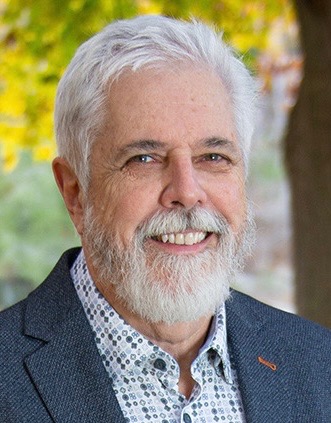
The photo of Clarence (below) is from Chatham-area farm writer and broadcaster Blair Andrews’ Farm Connection blog.

Wind power decision leaves many unanswered questions

Owen Roberts May 31st, 2010

Ontario’s chief medical officer of health, Dr. Arlene King, says wind turbines are not a health problem. Some people living within the vicinity of the machines have reported dizziness, headaches and sleep disturbance. The complaints prompted King to conduct a review of previously published studies mainly from abroad, and current legislation here. When she put them together in a report, she concluded Ontario’s nearly 700 wind turbines are not making people sick.

But there’s a lot more to this story. In isolation, wind turbines are a technology-driven, renewable energy source with the potential to contribute to the greening of Ontario. But what about their aesthetics? And what about their affect on farm animals? Or what about using land to produce energy rather than crops and livestock? Those are hot buttons for people everywhere.

Science and society clash when technology is not well understood or presented.   I cover the wind turbine decision in my Urban Cowboy column is today’s Guelph Mercury.

The wind farm photo below is from treehugger.

Perfect storm hits Ontario’s farm sector

Owen Roberts May 25th, 2010

The optimism that normally surrounds planting season is mired in a troubling forecast about Ontario farm income. As farmers put their 2010 crops in the ground, Ottawa is predicting they could lose as much as $500 million when they harvest in a few months. That’s the worst case scenario. But even the best case scenario has them deep in the hole. It could easily be one of the worst years ever for Ontario farmers, and it’s the topic of my Urban Cowboy column in today’s Guelph Mercury.

Farm groups such as the Ontario Federation of Agriculture are trying to sound the alarm bell and drum up support for relief from what federation president Bette Jean Crews calls a crisis. “It’s not farmers’ fault, it’s not the government’s fault, it’s a combination of factors that made for a perfect storm,” she says. “Government programs exist that will get us through one crisis, but not a multitude of crises all at the same time. The numbers are staggering and we need help.”

Crews says even the weather is wreaking havoc on farmers, such as the tornado that went through Grey and Bruce counties, yielding the photo below. This photo and others appear on the OFA website.

Horses unite rural and urban interests

Owen Roberts May 17th, 2010

In this week’s Urban Cowboy column, I write about Ontario’s growing interest in horses, and the equine expo that’s been developed to serve the market.

Early next month, all eyes in the equine community will fall on the University of Guelph Arkell Research Station when the equine expo gets underway there. It’s being staged by Guelph-based Canada’s Outdoor Shows Ltd., in partnership with the Arkell station and Equine Guelph, along with support from the Ontario Federation of Agriculture, the Ontario Equestrian Federation and Equine Canada.

The province’s 350,000 horses and 80,000 horse owners help anchor Ontario’s farm economy, and offer some stability when other parts of the livestock sector are having their ups and downs. About half of all the horses in Ontario reside on farms and acreages within 150 kilometres or so of Guelph. It’s become a world-renown horse hub, a centre for all things equine. That’s thanks in part to expertise at the Ontario Veterinary College and at Equine Guelph, an organization dedicated to research, education and training, performance, healthcare and industry development.

The photo below by Guelph photographer Martin Schwalbe of equine researcher Dr. Katrina Merkies from the university’s Kemptville campus first appeared in the university’s Research magazine, dedicated to equine studies.

Farmers understand animal welfare benefits

Owen Roberts May 10th, 2010

Healthy animals are profitable animals. And for farmers, profitability is the bottom line. Farmers who treat their animals poorly can face veterinary bills, and other costly problems – such as a turned-off, non-supportive public. But right now, for the most part, consumers are on farmers’ side.

And farmers aim to keep it that way.

Hon. Gerry Ritz, the federal minister of agriculture and agri-food, stopped at the University of Guelph recently to announce Ottawa was dedicating $3.4 million to help develop or update codes of good practice for livestock, particularly livestock handling. The funding will include funding for peer-reviewed, on-farm care-assessment measures. I write about this support in my Urban Cowboy column in today’s Guelph Mercury.

The photo below by Guelph photographer Martin Schwalbe shows Prof. Vern Osborne and graduate student Carolyn Borsy in the university’s dairy barn, where their research revealed water is an ideal vehicle for delivering nutrients to dairy cows during a critical phase of their milk cycle. Their story appears in the University of Guelph Research magazine.

Next »